
I want to urge Asheville homeowners to be diligent in protecting your home. There is a sinister villain lurking in dark places, silently trying to work its way into your home—and you may not be aware of its presence until you wake up one morning to the unpleasant reality of water damage.
That villain is "pressure creep", and it can silently work its way into your home through a weak or failing pressure regulating valve.
A recent service call at an Asheville-area residence revealed a water-pressure problem with serious consequences. A water-treatment filter housing had failed, releasing a substantial amount of water into the home's basement.
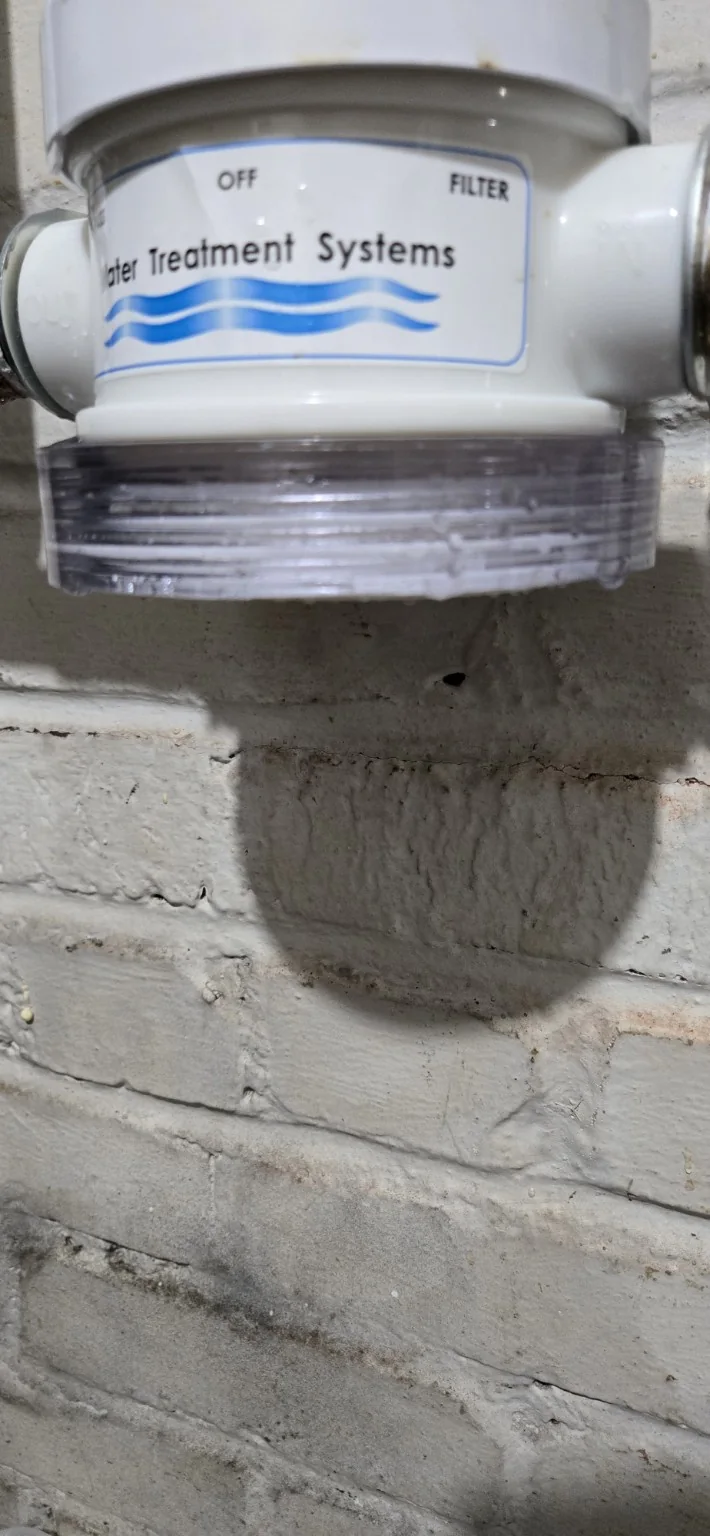
The housing was reported to have a maximum operating pressure of 100 psi.
During the day, water pressure at the residence was approximately 60 psi. But overnight, when household water use was minimal, pressure climbed above 145 psi.

A failing pressure-reducing valve was allowing the pressure inside the home to gradually increase.
Fortunately, failures this dramatic aren't what we typically encounter. In our experience servicing Asheville homes, deteriorating pressure-reducing valves are a recurring problem, but the warning signs are often much less obvious.
Why Asheville's water pressure can change overnight
Asheville's mountainous terrain presents unusual challenges for municipal water distribution.
City of Asheville publications have documented approximately 1,500 feet of elevation variation, more than 50 pressure zones, and distribution-system pressures exceeding 400 psi in some locations.
These extreme pressures are associated with municipal infrastructure, not normal household operating pressure. They illustrate the importance of pressure management in a system serving properties at significantly different elevations.
Water demand also plays an important role.
During the day, homes and businesses draw substantial amounts of water through the distribution network. Moving water encounters resistance within the pipelines, producing pressure losses.
Overnight, community water consumption decreases. As water movement slows, friction losses diminish, potentially allowing pressure at individual service connections to rise.
How much the pressure changes depends on the property's elevation, distribution zone, pumping operations, and other system conditions.
This becomes particularly important when a home's pressure-reducing valve is no longer functioning properly.
How pressure creep develops
A pressure-reducing valve, or PRV, regulates incoming municipal water pressure to a level appropriate for household plumbing.
As these valves age, internal components wear. Seals can deteriorate, and debris may prevent the valve from closing completely.
A weakening valve can still appear to function reasonably well while water is flowing. But when household water use stops, a small amount of higher-pressure water may continue passing through the valve.
Over time, downstream pressure gradually increases toward the incoming supply pressure.
We call this pressure creep.
The problem often becomes more noticeable overnight, when household water use stops for extended periods and municipal supply pressure may also increase.
Opening a faucet releases some of that accumulated pressure. By the time someone checks the system during normal daytime use, everything may appear fine.
The warning signs are often subtle
Most pressure-regulation problems we encounter don't announce themselves with a flooded basement.
More often, a homeowner might notice an intermittent drip from the water heater's temperature-and-pressure relief valve, commonly called the T&P valve.
Another indication might be a toilet fill valve that occasionally runs or fails to shut off properly.
These may seem like unrelated plumbing problems, and sometimes they are. A dripping T&P valve can also indicate thermal expansion, while a running toilet may simply have a worn seal or defective fill valve.
But either condition can justify looking more closely at household water pressure.
Thermal expansion deserves particular attention. As water heats inside a closed plumbing system, it expands and can increase pressure even when the PRV is working correctly. Thermal expansion and pressure creep are separate conditions, although they can occur together.
The important point is that a small, recurring plumbing problem may be the first indication of a larger pressure-control issue.
Replacing the leaking component without investigating the underlying pressure conditions may leave the real problem unresolved.
When the consequences become more serious
North Carolina's plumbing code generally requires pressure regulation when static building water pressure exceeds 80 psi, subject to specified exceptions.
At the Asheville residence described earlier, the overnight pressure exceeded 145 psi, substantially above the failed filter housing's reported 100 psi maximum operating rating.
The resulting water leak demonstrated the potential consequences of a pressurized component failure.
While the available evidence does not establish the exact contribution of excessive pressure to the housing's failure, the elevated pressure represented a serious condition requiring correction.
The investigation identified a failing PRV, which was replaced with a model appropriately rated for the incoming supply pressure.
The replacement corrected the overnight pressure creep.
The incident illustrates how a problem that can remain unnoticed for some time may eventually contribute to expensive plumbing or equipment damage.
Why we look for pressure problems during routine service
Our experience with pressure-regulation problems in Asheville has changed how we approach servicing water-treatment equipment.
We've established service policies intended to identify warning signs of deteriorating PRVs during every service visit to filtration systems we've installed on Asheville's municipal water distribution system.
The purpose is to recognize potential pressure problems before they become equipment failures or costly plumbing repairs.
A pressure reading taken at one moment doesn't always tell us what's happening throughout the day. When conditions suggest a possible regulating-valve problem, further evaluation may be necessary.
This is especially relevant in Asheville, where incoming municipal pressure can vary significantly depending on location and distribution conditions.
The lesson isn't simply that excessive water pressure can cause damage. It's that the warning signs of a failing pressure-reducing valve are often easy to overlook, and the absence of an obvious problem doesn't necessarily mean the plumbing is adequately protected.